
From roadmap to reality: making sense of the IReF timeline
Intro
The European Central Bank’s Integrated Reporting Framework (IReF) has moved from abstract concept to concrete roadmap, with the Eurosystem now confirming the main milestones for implementation. For banks, this timeline is more than a compliance date – it is a forcing function to tackle long‑standing data issues and rethink how statistical and prudential reporting are designed, governed and delivered.
What has the ECB actually confirmed?
The IReF programme aims to harmonise statistical reporting across euro area banks, replacing a patchwork of existing requirements with a single granular, standardised framework. Recent ECB communication has clarified the sequencing, giving institutions a clearer planning horizon.
The key milestones currently set out include:
- A public consultation on the draft IReF Regulation, planned for the second half of 2027, which will help shape the final legislative text.
- A one‑year pilot reporting phase starting in the second quarter of 2030, where reporting institutions will test their ability to meet the new granular data requirements and validate technical set‑ups.
- The first official IReF submissions in the second quarter of 2031, accompanied by an initial one‑year parallel reporting phase, during which existing statistical reports in scope will continue alongside IReF.
Taken together, these milestones mark the transition from investigation to implementation and give banks a multi‑year window to prepare – but not as much time as it may appear on paper.
Why the IReF timeline matters more than the end‑date
It is tempting to focus only on the first official reporting date, but the real pressure points sit earlier in the timeline. The detailed implementation plan was originally expected in late 2025 and has now been pushed back to mid‑2026, compressing the period in which banks will have full clarity on requirements.
This shorter “certain requirements” window means institutions will need to:
- Start work based on the direction of travel, not wait for every detail to be fixed.
- Invest in target data models, governance and architecture that can absorb changes without rework.
- Use the pilot phase strategically, treating it as a dress rehearsal for steady‑state operations, not as a last‑minute test.
In parallel, the ECB and industry bodies have been clear that IReF is envisaged as a first tangible step towards deeper integration of statistical and prudential reporting in Europe. That makes early design choices around data models and transformation logic particularly important.
The role of granular data and BIRD
At the heart of IReF is granular, standardised data that can be reused across multiple reports and purposes. Rather than building yet another layer of templates, the framework is underpinned by a logical data model and dictionary intended to support consistent sourcing, transformations and quality checks.
The ECB’s Banks’ Integrated Reporting Dictionary (BIRD) initiative is a key enabler here, offering a common reference model for how banks can map internal data to regulatory needs. When combined with a modern regulatory data platform, BIRD‑aligned models can help banks:
- Reduce reconciliation effort by sourcing statistical, prudential and resolution reporting from a single, governed data layer.
- Increase transparency, with end‑to‑end traceability from source systems through transformations to reported figures.
- Adapt more quickly when regulatory or statistical requirements change, since the heavy lifting is done at the data‑model level.
Turning the roadmap into a transformation plan
For many institutions, the question is no longer whether IReF will happen, but how to approach the journey from 2026 to steady state. A practical plan typically involves four overlapping workstreams:
- Strategic assessment
Take stock of your current reporting landscape, data flows and architecture. Identify where statistical, prudential and risk reports already share data and where fragmentation creates duplication and inconsistency. - Target data model and BIRD alignment
Define a target regulatory data model aligned, where possible, to BIRD and IReF concepts, and map critical data elements from source systems into this layer. This is the foundation for reusing the same granular data across multiple reports. - Technology and automation
Evaluate whether your current infrastructure can support the level of granularity, traceability and frequency implied by IReF. Many banks are turning to RegTech platforms that can manage end‑to‑end data pipelines, controls and reporting logic in a more flexible, model‑driven way. - Operating model and governance
Clarify responsibilities across risk, finance, regulatory reporting and IT, including ownership of the regulatory data model and change process. Strengthen data quality management, with clear metrics and escalation paths, to avoid last‑minute firefighting once pilot reporting begins.
Where Suade fits in
Suade was founded on the principle that regulation should be data‑driven, transparent and scalable, and that technology can turn compliance from a cost centre into a strategic capability. Our regulatory data model and platform were built to support granular, standardised reporting, making them a natural match for the direction set by IReF and BIRD.
By combining a model‑driven architecture with explainable, auditable workflows, Suade helps institutions prepare for IReF by:
- Creating a single, reusable regulatory data layer aligned with evolving European requirements.
- Reducing the complexity of onboarding new templates and taxonomies.
- Providing the transparency supervisors increasingly expect across the entire reporting chain.
As the Eurosystem moves from roadmap to implementation, the banks that act early on data and architecture will be best placed to absorb change, minimise disruption and unlock value from the investment that IReF demands.
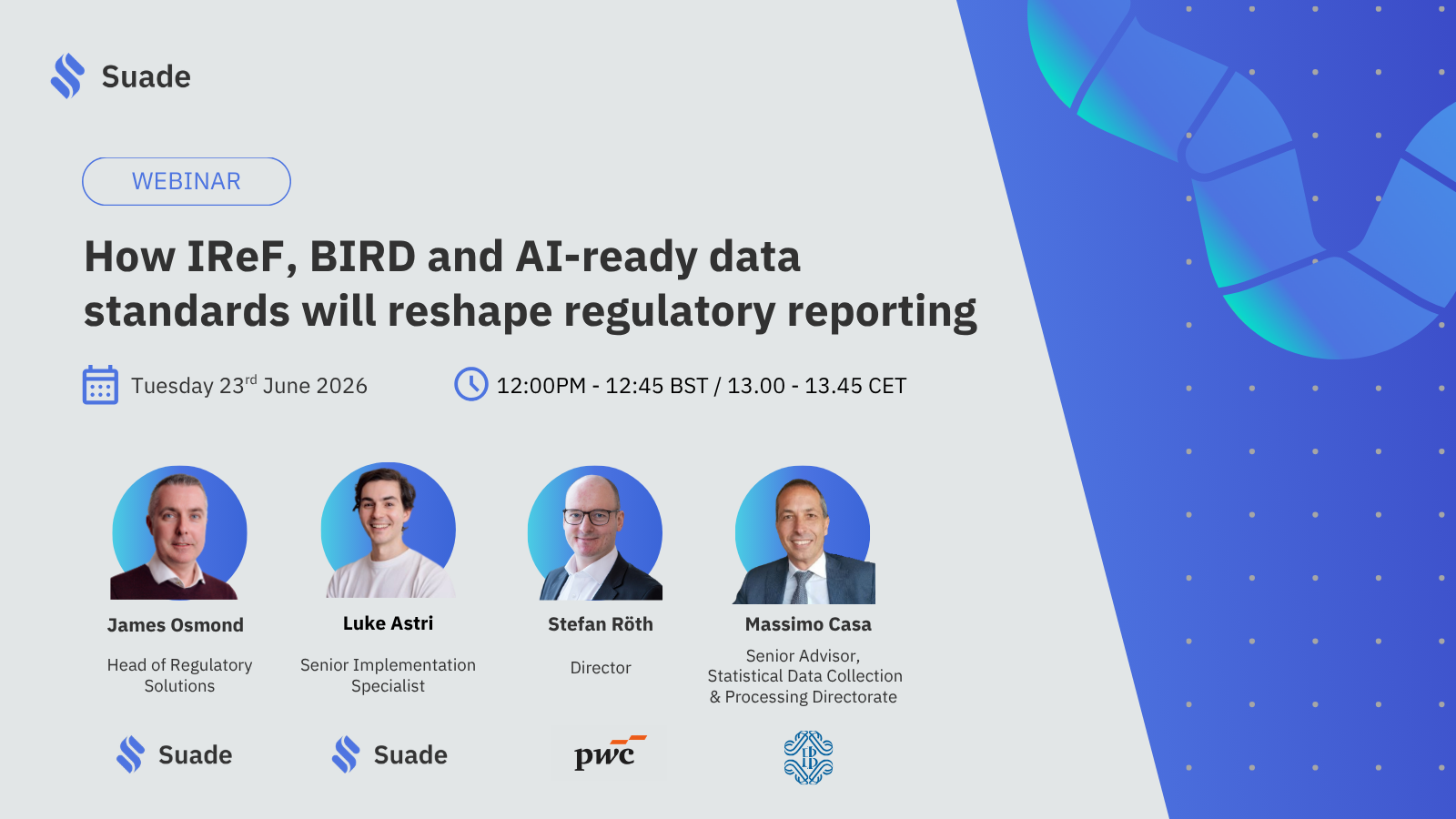
Get ready for Europe's data reporting shift
In this webinar, Massimo Casa (Banca d'Italia, co-chair of the BIRD Steering Group) joins Stefan Röth (PwC) to examine the latest IReF developments and their implications for regulatory reporting.